The City of the Dead and Silk Spinners
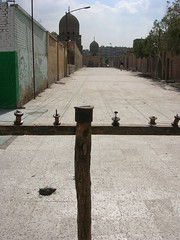
On Saturday we went for a drive – interspersed with bits of walk- - through the City of the Dead. It is not as bad or as morbid as it sounds. Apparently people started to live among the graves because there were many large family graves.
In most of the Islamic world the body after death is not particularly revered. Traditionally a body is wrapped or sewn into a shroud and put into the earth within twenty four hours, and most of the funeral is held well after the body is buried. I horrified students at the American University by using fabrics sold for shrouds in the class I taught there – but it is like a cross between bandaging and cheesecloth, soft and fine and beautiful. In Saudi Arabia graves are even unmarked, though in most countries there is a vertical and plain gravestone.
In Egypt death is much more important. I often wonder if this is a carry-over in some way from the traditions of the Pharaohs. It would be hard to live in the shadow of the pyramids and be tossed into an unmarked grave! Large family graves or crypts can be the size of large houses, and caretakers would look after them. There was often a room for a caretaker and often more luxurious rooms available too so the family could come to stay when there was a funeral. Caretakers married and had children, and those children married and had children – and slowly the living began to outnumber the dead.
According to Lonely Planet there are worse places to live – low rise buildings, cheap accommodation and very quiet neighbours.
High rise buildings are sneaking in, but there are some really lovely old mosques, and some very interesting graves. Have a look at the photographs. I amazed myself by climbing a minaret – and it was HIGH. And very dark. And narrow. And it had a cable climbing the stairs beside us with odd bits sticking out to trip the unwary. Worse – it was the cable that broadcast the Muezzin’s call so if one of us tripped on it there would be no call to prayer to break the fast! I don’t like heights – or narrow places – so I am still surprised that I did it.
Best of all, as we drove we saw a large spinning thing with a few men moving around it. Mary Heard was with us, and commented. A bit of chat in the car decided it was probably a knife sharpener.
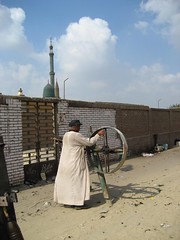
Ten seconds later we passed another one – actually two. A large vertical wheel was mounted on three sticks, and threads led off the wheels for metres – about one hundred metres at least – down a long alley.
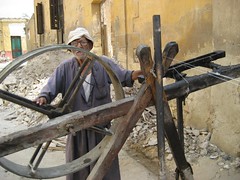
The men were spinning silk. They had thread, but it was very fine. They were combining six threads to make a thread like a fine cord, then plying three of these together so the cord thickened again and did not try to tangle itself.
As they spun the wheel and the threads twisted together the line shortened – so they ‘walked’ the wheels down the alley. Different rocks on the ground marked different points where the cords were twisted enough for the next stage. It was fascinating. We bought a heavy twist – about a kilo each – of the finished cord for less than a dollar a twist – one natural and one a rich dark burgundy.
I am putting in photos of each stage and will not try to group these. The trick will be to get them in order as I have to remember to load them backwards.

The spinners as we first saw them, with our group behind

Walking the frame as he spins - with a hand cleverly through a gap in the threads

Thread before the spinning as cord

The wheel

Hooks to support threads at the halfway point

Hassan spinning the wheel

The man in the far distance is hooking the threads arond the spools at that end.

Tying off the hanks of silk
In most of the Islamic world the body after death is not particularly revered. Traditionally a body is wrapped or sewn into a shroud and put into the earth within twenty four hours, and most of the funeral is held well after the body is buried. I horrified students at the American University by using fabrics sold for shrouds in the class I taught there – but it is like a cross between bandaging and cheesecloth, soft and fine and beautiful. In Saudi Arabia graves are even unmarked, though in most countries there is a vertical and plain gravestone.
In Egypt death is much more important. I often wonder if this is a carry-over in some way from the traditions of the Pharaohs. It would be hard to live in the shadow of the pyramids and be tossed into an unmarked grave! Large family graves or crypts can be the size of large houses, and caretakers would look after them. There was often a room for a caretaker and often more luxurious rooms available too so the family could come to stay when there was a funeral. Caretakers married and had children, and those children married and had children – and slowly the living began to outnumber the dead.
According to Lonely Planet there are worse places to live – low rise buildings, cheap accommodation and very quiet neighbours.
High rise buildings are sneaking in, but there are some really lovely old mosques, and some very interesting graves. Have a look at the photographs. I amazed myself by climbing a minaret – and it was HIGH. And very dark. And narrow. And it had a cable climbing the stairs beside us with odd bits sticking out to trip the unwary. Worse – it was the cable that broadcast the Muezzin’s call so if one of us tripped on it there would be no call to prayer to break the fast! I don’t like heights – or narrow places – so I am still surprised that I did it.
Best of all, as we drove we saw a large spinning thing with a few men moving around it. Mary Heard was with us, and commented. A bit of chat in the car decided it was probably a knife sharpener.
Ten seconds later we passed another one – actually two. A large vertical wheel was mounted on three sticks, and threads led off the wheels for metres – about one hundred metres at least – down a long alley.
The men were spinning silk. They had thread, but it was very fine. They were combining six threads to make a thread like a fine cord, then plying three of these together so the cord thickened again and did not try to tangle itself.
As they spun the wheel and the threads twisted together the line shortened – so they ‘walked’ the wheels down the alley. Different rocks on the ground marked different points where the cords were twisted enough for the next stage. It was fascinating. We bought a heavy twist – about a kilo each – of the finished cord for less than a dollar a twist – one natural and one a rich dark burgundy.
I am putting in photos of each stage and will not try to group these. The trick will be to get them in order as I have to remember to load them backwards.
The spinners as we first saw them, with our group behind
Walking the frame as he spins - with a hand cleverly through a gap in the threads
Thread before the spinning as cord
The wheel
Hooks to support threads at the halfway point
Hassan spinning the wheel
The man in the far distance is hooking the threads arond the spools at that end.
Tying off the hanks of silk